Who We Are
We offer TIC services to enhance fire, life, and electrical safety globally, confirming compliance and reducing risks.
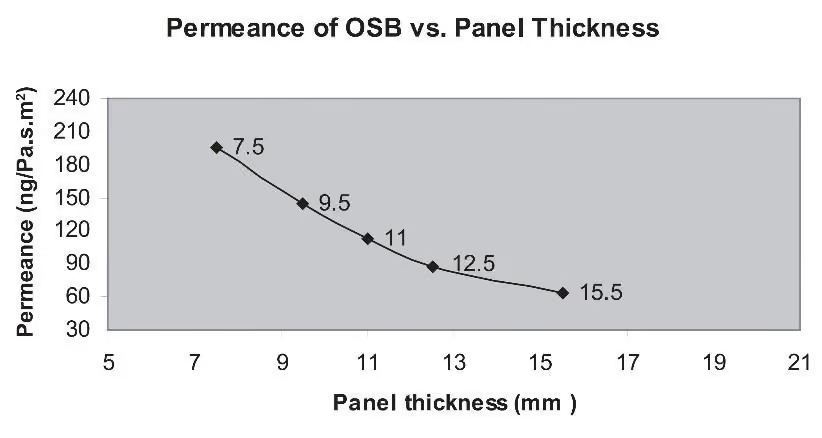
The water vapor permeability or permeance of a structural wood panel is the rate at which water vapor will pass through the panel in the presence of a pressure gradient. The Structural Board Association 1 contracted with Forintek Canada Corp to undertake a series of “wet cup” tests on oriented strand board (OSB) and waferboard panels in accordance with test procedures in ASTM E96, Standard Test Methods for Water Vapor Transmission of Materials . The chart below gives the permeance for a range of thicknesses from 7.5 mm (5/16”) to 15.5 mm (5/8”).
Panels with a water vapor permeance of 60 ng/Pa.s.m 2 (1.0 perm) or less are permitted to be used as vapor barriers, while panels with a permeance of 120 ng/Pa.s.m 2 (2 perms) or more are considered to pass sufficient water vapor that a wall cavity will dry out when constructed with green lumber. For example, nominal 15.5 mm (5/8”) or thicker OSB panels can be installed as subfloor over unheated spaces without the need of a separate vapor barrier 2 , while nominal 11 mm (7/16”) or thinner wall sheathing panels will allow a wall cavity containing green stud lumber and glass fiber insulation to reach an equilibrium moisture content below 19% in about 60 days.
This information was taken from a comparative study of wall sheathing performance by the University of Waterloo Building Engineering Group. (Waterloo, Ontario, Canada)
1 The assets of the Structural Board Association were purchased by TECO in 2008, and included a series of Technical Bulletins like this one, the contents of which are provided here in their entirety.
2 Per the requirement in the 2005 National Building Code of Canada. The requirement is for “dry cup” results, which are typicallylower than the tabulated “wet cup” results.