Who We Are
We offer TIC services to enhance fire, life, and electrical safety globally, confirming compliance and reducing risks.
Dyne Fire Protection Labs, an NFPA Global Solutions company, provides independent laboratory testing for Corrosion & Microbiologically Influenced Corrosion (MIC) in fire protections systems. Testing is conducted to evaluate microbial activity, water quality characteristics, and other conditions that contribute to corrosion and MIC.
Fire protection systems are subject to water quality, chemistry, and environmental conditions that can influence corrosion activity over time. Corrosion & MIC testing provides information on corrosive properties and other contributing factors that can be used to assess corrosion risk and support compliance with applicable NFPA requirements.
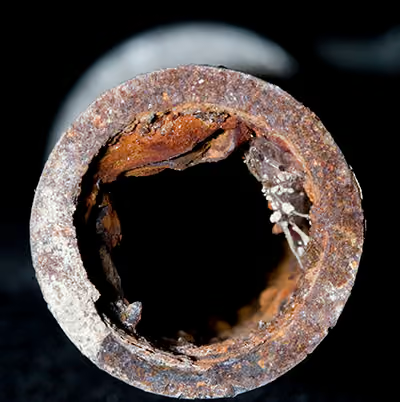
Corrosion occurs in all fire sprinkler systems and can affect performance over time. Corrosion products, mineral deposits, and microbial activity can restrict water flow and impair mechanical operation, leaving facilities vulnerable.
Because corrosion conditions vary between systems, the corrosion panel provides an assessment of corrosion risk rather than a pass/fail result. The results can help guide corrosion mitigation efforts and evaluate their effectiveness through ongoing testing.
Higher corrosion risk results indicate a greater likelihood of issues related to general corrosion and/or MIC.
To help identify and address corrosion-related risks, NFPA standards establish requirements for evaluating water supplies, environmental conditions, and indications of MIC.
NFPA 25 requires an assessment of the internal condition of piping at a minimum of every five years. As part of this assessment, tubercules or slime, if present, must be tested for indications of MIC. NFPA 13 requires the evaluation of water supplies and environmental conditions for the existence of microbes and conditions that contribute to MIC, as well as conditions that contribute to unusual corrosive properties.
Testing is commonly performed during system installation, as part of periodic system assessments, when investigating signs of corrosion activity, or when evaluating the effectiveness of corrosion mitigation efforts. These services are typically used by building owners, facility managers, contractors, consultants, insurers, and fire protection professionals responsible for the inspection, maintenance, and long-term performance of water-based fire protection systems.
Key Testing Capabilities Include:
Standard Turnaround: 5-business days
Expedited Testing Available: Contact us for pricing.
Quantity Needed
1 kit = 1 sample
2 kits = 2 samples
3 kits = 3 samples
Applicable Testing
Kit Includes
Note: Corrosion & MIC kits have an expiration date (typically 1 year). Check the date on the kit box before submitting samples.
Shipping Information
Ground shipping to you is included as well as return labels (UPS/USPS) within the contiguous United States (limited free 1-way shipping to Alaska, Hawaii, Puerto Rico, and Canada, inquire for details). Expedited shipping is available at your cost.
Corrosion & MIC testing helps reduce risk by identifying the water quality conditions, microorganisms, and environmental factors that contribute to accelerated corrosion within fire protection systems. Left unchecked, corrosion and MIC can lead to pipe deterioration, restricted water flow, equipment impairment, and costly system failures that compromise life safety.
Laboratory analysis provides objective data on corrosive properties and microbial activity, allowing owners, contractors, and facility managers to make informed maintenance, remediation, and replacement decisions before significant damage occurs. Testing also supports compliance with NFPA requirements related to evaluating conditions that contribute to corrosion and MIC, as well as assessing system conditions when corrosion-related indicators are present.
By proactively identifying risks and documenting system conditions, Corrosion & MIC testing helps support system reliability, extend service life, and demonstrate a commitment to code compliance and fire protection readiness.
Depending on the investigation, you may consider submitting:
We can evaluate:
We offer a combination of laboratory analyses designed to identify corrosion mechanisms and the presence of microbiologically influenced corrosion (MIC) within fire protection systems. Testing includes water chemistry analysis of chloride, sulfate, hardness, pH, alkalinity, and dissolved oxygen, as well as bacterial analysis for iron reducing bacteria, sulfur oxidizing bacteria, sulfate reducing bacteria, and corrosive methanogens.
In the collection kit, there are instructions on how to collect samples. If it is a water sample, you fill a syringe and push it through a filter and put that filter into a preservation buffer. You then fill up a separate bottle with the same water. If it is a solid, you scoop up some sample of solid and put it in the preservation buffer (MIC only) – you still need to fill up the sample bottle with water.
If you are replacing a sprinkler head or draining the system, that is a great time to take a water sample. Consider our Dropmaster product to assist when changing sprinkler heads. If your system is under pressure, you will most likely need to drain it to get a water sample.
The goal is to obtain a representative sample of the system. It is best to sample near areas of concern for MIC issues. If this is not feasible, you can take a sample of the water wherever you can obtain water access. When sprinklers are being replaced, or when maintenance is being done on the system may be the best time to get a sample.
A 500 mL bottle of water is required, along with either 60 mL of water pushed through a syringe onto a filter or 250 milligrams of solid material. Tools for both options are supplied in the collection kit with instructions.
Our testing can evaluate microorganisms commonly associated with corrosion in fire protection systems, including:
The corrosion panel is designed to cover many variables of corrosion. The testing will show an increased level of bacterial activity which you then can reasonably assume that MIC is at minimum a part of the cause of corrosion.
Test results are delivered via email within 5 business days or less from the receipt of the sample(s).
You can contact Dyne Fire Protection Labs to discuss your testing needs.
Accordion content will appear here
It is the responsibility of the property owner or designated representative to ensure the sample information provided is correct and to correct deficiencies or impairments, including identifying and replacing any recalled products. The results relate only to the sample(s) tested using a limited number of laboratory-scale methods and do not guarantee the system will operate properly.
For more information,please review our Legal Notice page.
Dyne Fire Protection Labs, an NFPA Global Solutions company, is a full-service NFPA 25 testing laboratory that combines fire protection industry expertise with advanced laboratory testing capabilities to help organizations evaluate corrosion risk and MIC. Our approach focuses on delivering timely, objective data that supports maintenance, remediation, and compliance-related decision making.
We deliver test reports in five business days or less, but to further improve speed and accuracy, we have implemented quantitative polymerase chain reaction (qPCR) technology for MIC analysis. Widely used in industries such as pharmaceuticals and oil & gas, qPCR enables targeted microbial DNA to be identified and quantified in hours rather than the days or weeks often associated with traditional incubation methods.
To simplify sample collection and shipping, we provide free Corrosion & MIC sample kits that include a preservative buffer designed to stabilize microbial conditions at the time of collection. This helps maintain sample integrity during transit, eliminates the need for overnight shipping on ice, and supports reliable testing results.
Testing Advantages
What’s more, our service can also be used to evaluate remediation efforts (e.g. nitrogen, biocide, etc.) that may have already been taken or will be taken to prove they remain effective over time.