Las marcas de NFPA Global Solutions significan seguridad y calidad, asegurando que los productos cumplen con estándares rigurosos y generan confianza en el mercado.
Las marcas de NFPA Global Solutions simbolizan seguridad y calidad, asegurando que los productos cumplen con estándares rigurosos y generan confianza en el mercado.
Obtenga kits gratuitos de espuma, anticongelante, productos químicos secos y rociadores estándar con envío dentro de EE. UU. Especifique la cantidad necesaria.
Gradestamp Explanation for OSB and Waferboard in Canada
OSB, and its early generation cousin waferboard, is one of the primary structural wood-based panels utilized in building construction in Canada. The National Building Code of Canada (NBCC)—in Part 9: Housing and Small Buildings, Section 9.23: Wood-Frame Construction—lists a variety of standards that apply to wood-based panels that are suitable for use as subflooring, roof sheathing, and wall sheathing. Two standards apply to OSB and waferboard that can meet the requirements for subfloor, and roof and wall sheathing:
CAN/CSA O325, Construction Sheathing
CSA O437, OSB and Waferboard
CAN/CSA O325 applies to OSB and waferboard and also certain types of plywood, while CSA O437 applies to OSB and waferboard only.
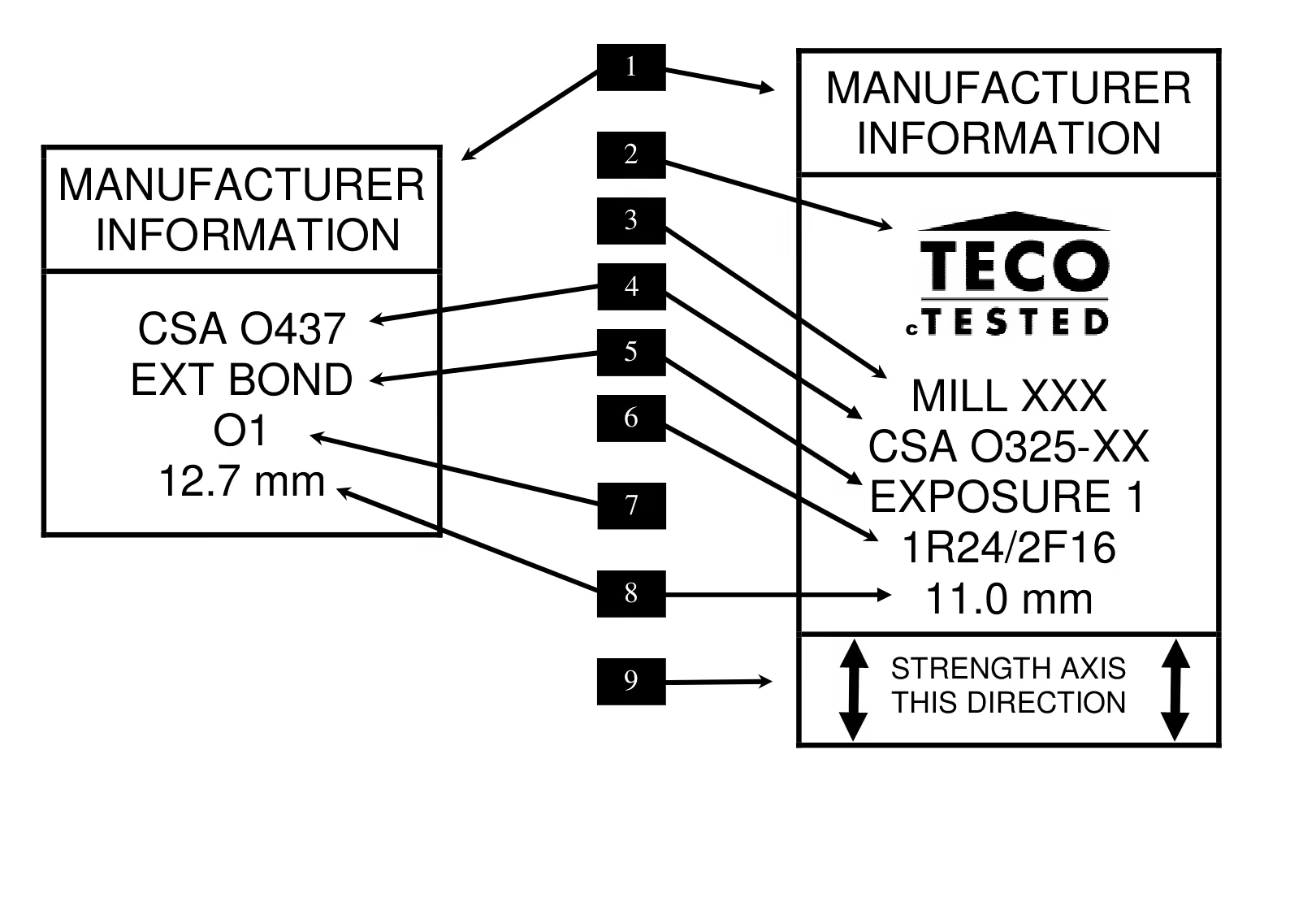
Panels that are self-certified by the manufacturer (for CSA O437) or certified by an accredited certification body like TECO (for CAN/CSA O325) (see TECO's accreditation listing on the Standards Council of Canada website at www.scc.ca) must be marked to include such information as the manufacturer of the material, the standard to which it is produced, and that the material is of an exterior type (see NBCC Paragraph 9.3.2.4). There is other information included on gradestamps and that information is explained below. Two different gradestamp examples are included at the end of this document for user benefit and reference.
Manufacturer information. Additional information may be stamped on the panel by the manufacturer. Such information might include: Manufacturer's name or logo, "SIZED FOR SPACING", "THIS SIDE DOWN", tongue and groove, minimum edge and/or end spacing, etc. to assist in installation.
Certification body. TECO is an accredited certification body recognized and accepted in Canada by the Standards Council of Canada (SCC). TECO's certification mark, TECO TESTED with the roof logo, is registered with the Canadian Intellectual Property Office (CIPO). A lower case "c" is placed before the certification mark to identify product for Canada.
Mill number. The mill number is assigned by TECO to identify the individual panel manufacturer. TECO mill numbers and corresponding manufacturer names are listed on the TECO website at www.tecotested.com/clients.
Product standard. CAN/CSA O325 applies to structural-use wood-based panels such as OSB and waferboard but also certain types of plywood, while CSA O437 applies to OSB and waferboard only. The year the standard is approved is included after the standard designation (e.g., CSA O325-12).
Bond classification. An Exterior classification is a bond that is unaffected by exposure to extreme conditions of moisture and temperature. An Exposure 1 classification means that the panels are suitable for uses not permanently exposed to the weather.
Span rating for CAN/CSA O325 panels. The span rating identifies the recommended maximum center-to-center support spacing under normal use conditions. The end use marks specify the panel application as: 1F (single floor), 2F (subfloor requiring separate underlayment), 1R (roof sheathing), 2R (roof sheathing requiring edge support) or W (wall sheathing). Span marks specify the recommended framing member spacing (e.g., 16, 24, 32, etc.) and only applicable to panels marked with CSA O325.
Grade marks for CSA O437 panels. The grade marks for panels manufactured to CSA O437 are one of four designations: R1, O1, O2, and Shop. In the case of R1, O1, and O2, the first character signifies whether the particles in the panel are oriented Randomly (R) or Aligned (O), and whether the panel has Grade 1 or Grade 2 properties.
Nominal thickness. The thickness in nearest 0.5 millimeters. Table 8C in CAN/CSA O325 and Table 2 in CSA O437 show typical panel thicknesses.
Aligned face furnish for CAN/CSA O325. The strength axis is parallel to the flake orientation of the panel face and back surfaces, which is generally aligned with the long panel dimension.