Who We Are
Ofrecemos servicios TIC para mejorar la seguridad contra incendios, la seguridad humana y la seguridad eléctrica a nivel global, garantizando el cumplimiento y reduciendo riesgos.
Dyne Fire Protection Labs prueba todo tipo de rociadores contra incendios, incluidos los estándar, de respuesta rápida y secos. Nuestro laboratorio utiliza normas del sector para probar sus rociadores y asegurarse de que funcionarán eficazmente en una situación de incendio.
Fire sprinkler performance can change over time in ways that are not always visible during inspections. Corrosion, obstructions, coating degradation, loading, and other age-related conditions may affect sprinkler operation.
NFPA 25 requires periodic sprinkler testing to verify continued performance against established acceptance criteria. Test results help support maintenance decisions, identify potential deficiencies, and demonstrate compliance with inspection, testing, and maintenance requirements.
.png)
NFPA 25 requires building owners to have a sample of the installed sprinklers tested by an approved testing lab. Dyne tests the response time of the sprinklers to confirm they will release in a specified amount of time when exposed to a defined temperature and air flow. The acceptable response time is based on a response time index (RTI). The RTI requirements are listed below. Note that a sprinkler coated with a material for corrosion resistance (wax for example) is allowed extra time as defined in UL 199. The response time of the coated standard response sprinkler is 180 seconds or the maximum response time (whichever is greater).
Sprinkler Definitions:
ESFR RTI value should not exceed 50 (meters-seconds)1/2
Fast Response RTI value should not exceed 65 (meters-seconds)1/2
Standard Response RTI value should not exceed 350 (meters-seconds)1/2
If the response time does not meet the RTI requirement, the sprinkler response time will be marked as “FAIL”. Failure to meet the RTI requirement may result from, but is not limited to, the following:
Additionally, if the release mechanism does not activate, the water seal does not release, pressure loss is not detected due to a blocked waterway, or the water seal remains partially attached, the sprinkler will be marked as “FAIL” on the report. If a sprinkler fails to meet the requirements as defined above, all sprinklers within the area represented by the failure shall be replaced per NFPA 25 2026 Ed. Section 5.3.1.3.
Key Capabilities Include:
Standard Turnaround: 5-business days
Expedited Testing Available: Contact us for pricing.
Quantity Needed
1 kit = Room for 4 sprinklers (minimum of 4 sprinklers required by NFPA 25)
2 kits = Room for up to 8 sprinklers
3 kits = Room for up to 12 sprinklers
Applicable Testing
Kits Include
Quantity Needed
(minimum of 4 sprinklers required by NFPA 25)
1 kit = Room for 1 dry sprinkler
2 kits = Room for 2 dry sprinklers
3 kits = Room for 3 dry sprinklers
Kits Include
Small: holds one (1) dry sprinkler up to 20"
Large: holds one (1) dry sprinkler up to 21" to 42"
Shipping Information
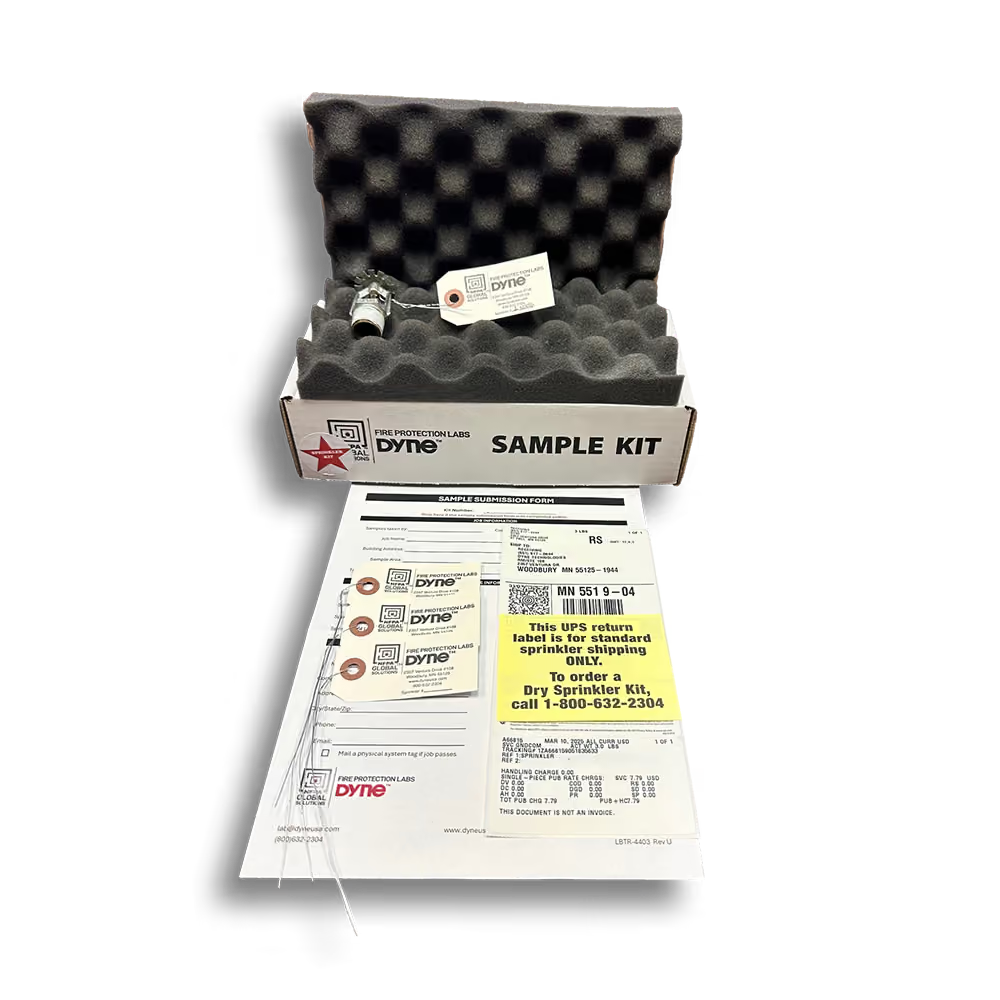
Ground shipping to you is included, as well as return labels (UPS/USPS) within the contiguous United States (limited free 1-way shipping to Alaska, Hawaii, Puerto Rico, and Canada; inquire for details). Expedited shipping is available at your cost.
Overtime, corrosion, obstructions, mechanical damage, environmental exposure, and degradation can impact sprinkler performance in ways that are not always apparent through visual inspection alone. Left unaddressed, these conditions can compromise system reliability and increase the risk of impaired fire protection. Fire sprinkler testing helps reduce this risk by identifying issues that could be detrimental to a sprinkler’s ability to function as intended prior to a fire event.
Laboratory testing provides objective data on sprinkler operating characteristics, including operating characteristics, including sensitivity and functionality. This information allows owners, contractors, facility managers, and fire protection professionals to make informed maintenance, replacement, and risk management decisions before performance issues lead to system failures. Testing also supports compliance with NFPA requirements that include the testing of representative sprinkler samples and the evaluation of sprinklers that may be affected by age, environmental conditions, corrosion, loading, or physical damage.
By proactively evaluating and documenting sprinkler performance, fire sprinkler testing helps support code compliance, maintain system reliability, and protect life safety.
Dyne Fire Protection Labs tests all types of fire sprinklers:
• Standard
• Fast Response
• Dry
See fire sprinkler testing intervals chart (link).
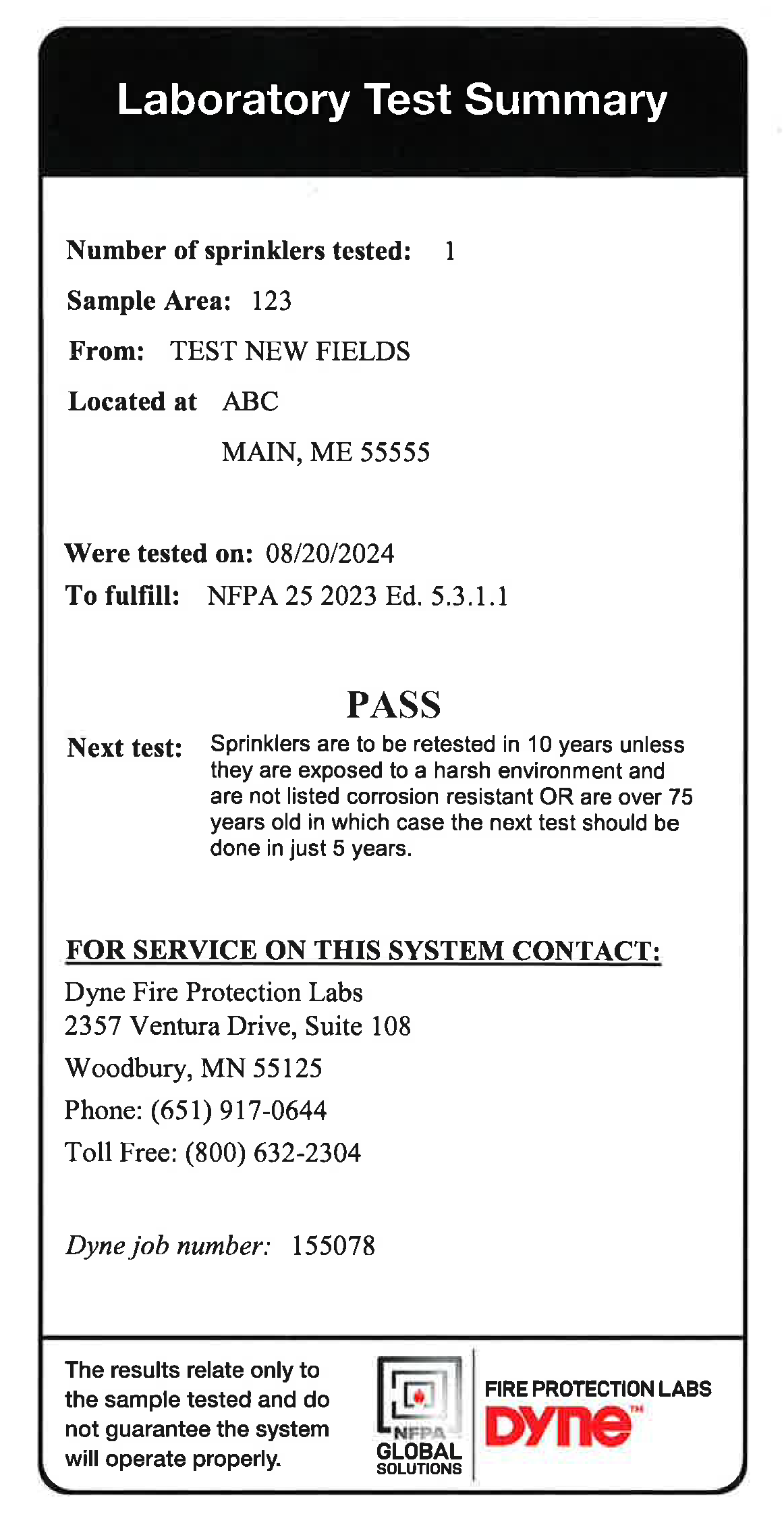
Test results are delivered via email within 5 business days or less from the receipt of the sample(s). System tags for passing samples are mailed via USPS by request on the sample return form.
Yes dry sprinklers are also required to be tested. In fact, dry sprinklers have been shown to be more likely to fail sooner in the field and as a result, they must be either replaced or tested every 20 years (previous versions 15 years) and every 10 years after that.
We provide sprinkler tags in our kits, but we also have a downloadable PDF (link) under Resources that you can use to make tags. We recommend that the sprinklers are labeled to match the sprinkler sample return form (ie #1 office, #2 garage, #3 warehouse, #4 lab).
You can contact Dyne Fire Protection Labs to discuss your testing needs.
El contenido del acordeón aparecerá aquí
It is the responsibility of the property owner or designated representative to ensure the sample information provided is correct and to correct deficiencies or impairments, including identifying and replacing any recalled products. The results relate only to the sample(s) tested using a limited number of laboratory-scale methods and do not guarantee the system will operate properly.
For more information, please review our Legal Notice page.
Dyne Fire Protection Labs, an NFPA Global Solutions company, is a full-service NFPA 25 testing laboratory that combines fire protection industry expertise with specialized fire sprinkler testing services. Our approach focuses on providing objective laboratory data that helps organizations evaluate sprinkler performance, support inspection and maintenance programs, and make informed decisions related to system reliability, compliance, and life safety.
With more than 25 years of testing experience, we understand the challenges associated with maintaining fire sprinkler systems throughout their service life. Environmental conditions, corrosion, obstructions, water quality issues, mechanical damage, and age-related deterioration can all affect sprinkler performance in ways that are not always apparent during visual inspections. Our testing services help organizations assess sprinkler operating characteristics, document results, and maintain confidence that their systems will perform as intended when needed.
Testing Advantages:
Order Your Sprinkler Kit